
Path of the Zadar Sun
Path of the Zadar Sun is a practice-as-research composition by Phil Bush for the Global Sound Movement, marking ten years of sustained international research.
Path of the Zadar Sun is a practice-as-research composition by Phil Bush for the Global Sound Movement (GSM), marking ten years of sustained international research into environmental sound, place, and cultural listening.
The work is centred on the Sea Organ (Morske Orgulje) in Zadar, Croatia—an architectural sound sculpture designed by Nikola Bašić (2005) that transforms tidal motion into continuously evolving harmonic sound. In this composition, the Sea Organ functions not as illustrative material but as the primary compositional system: its tidal rhythms determine tempo, pitch centre, and formal development, producing a structure that is contingent on environmental forces rather than authorial control.
The research originality lies in conceptualising lunar gravity as an active compositional agent. As tidal behaviour is shaped by the moon’s gravitational pull, the Sea Organ’s sonic output is framed as a collaboration between architecture, sea, and celestial motion. This approach extends traditions of environmental and ecological music associated with composers such as John Luther Adams and Pauline Oliveros, advancing them through site-specific, architectural practice rather than concert-based composition.
Alongside the Sea Organ, the work integrates selected materials from GSM’s decade-long global sound archive, gathered through international field-recording and participatory sound projects. These sounds are harmonically constrained by the Adriatic framework, creating a dialogue between geographically diverse sonic cultures and the specificity of place. This methodology reflects GSM’s sustained research rigour in field recording, curation, and ethical engagement with environmental sound.
The work is significant both as a research output and as an impact-enabling artefact. By situating complex ideas of ecology, astronomy, and sound within an accessible public context, Path of the Zadar Sun supports non-specialist engagement with environmental awareness, listening practices, and cultural interconnectedness. As such, it operates at the intersection of research excellence and public impact, exemplifying how practice-as-research can generate internationally relevant knowledge while fostering meaningful engagement beyond academia.
Addtional insight
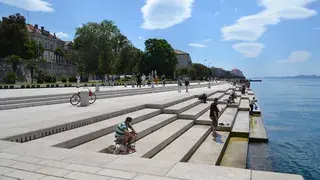
Listen on Spotify
Discover the story of Morske Musak, a project inspired by Croatia’s remarkable Sea Organ powered entirely by the movement of the sea, now on Spotify.
Watch on YouTube
Step inside the world of Morske Musak. Inspired by Croatia’s remarkable Sea Organ, this exhibition reveals how the power of the sea can become music. Watch on YouTube.
Additional Information
Originality
The output demonstrates originality through a novel compositional framework in which environmental and cosmological forces (tidal motion and lunar gravity) act as determinative musical agents, extending environmental composition practices articulated by Adams, J. L. (2009).
It advances sound art practice by reframing architectural sound sculpture as a dynamic compositional system, aligned with planetary-scale thinking discussed by Kahn, D. (2013), realised through original practice rather than representation.
The work integrates global archival sound materials within a site-specific harmonic and temporal framework, informed by relational theories of movement and perception articulated by Ingold, T. (2011), resulting in a distinctive, non-linear compositional form.
The environment encourages experimental, cross-disciplinary practice, integrating architecture, environmental science, and sonic arts within a coherent research culture.
Long-term support for archive-driven composition enables iterative innovation, allowing individual outputs such as Path of the Zadar Sun to emerge from cumulative research rather than isolated experimentation.
Significance
The output contributes significantly to contemporary discourses on listening as an ecological and ethical practice, resonating with the expanded listening methodologies developed by Oliveros, P. (2005).
It extends the cultural significance of soundscape studies by embedding acoustic ecology within architectural and astronomical processes, building upon the legacy of Schafer, R. M. (1977).
The work makes a substantive contribution to international sonic art practice, positioning public, non-human systems as co-composers, consistent with perspectives articulated by LaBelle, B. (2006).
The research environment fosters international, site-responsive practice, enabling works that engage with culturally and geographically specific sound ecologies at scale.
GSM’s commitment to public-facing sonic works supports the translation of research into accessible, non-specialist contexts, reinforcing impact-adjacent significance beyond academia.
Rigour
The output contributes significantly to contemporary discourses on listening as an ecological and ethical practice, resonating with the expanded listening methodologies developed by Oliveros, P. (2005).
It extends the cultural significance of soundscape studies by embedding acoustic ecology within architectural and astronomical processes, building upon the legacy of Schafer, R. M. (1977).
The work makes a substantive contribution to international sonic art practice, positioning public, non-human systems as co-composers, consistent with perspectives articulated by LaBelle, B. (2006).
The research environment fosters international, site-responsive practice, enabling works that engage with culturally and geographically specific sound ecologies at scale.
GSM’s commitment to public-facing sonic works supports the translation of research into accessible, non-specialist contexts, reinforcing impact-adjacent significance beyond academia.
Bibliography
Adams, J. L. (2009) - The Place Where You Go to Listen: In Search of an Ecology of Music. Middletown, CT: Wesleyan University Press.
Oliveros, P. (2005) - Deep Listening: A Composer’s Sound Practice. New York: iUniverse.
Schafer, R. M. (1977) - The Tuning of the World. New York: Knopf.
LaBelle, B. (2006) - Background Noise: Perspectives on Sound Art. New York: Continuum.
Blesser, B. and Salter, L.-R. (2007) - Spaces Speak, Are You Listening? Experiencing Aural Architecture. Cambridge, MA: MIT Press.
Thompson, E. (2007) - The Soundscape of Modernity. Cambridge, MA: MIT Press.
Lane, C. and Carlyle, A. (eds.) (2013) - In the Field: The Art of Field Recording. Axminster: Uniformbooks.
Kahn, D. (2013) - Earth Sound Earth Signal. Berkeley: University of California Press.
Truax, B. (2001) - Acoustic Communication. 2nd edn. Westport, CT: Ablex.
Ingold, T. (2011) - Being Alive: Essays on Movement, Knowledge and Description. London: Routledge.
Related Articles

Hidden Melodies
Explore Hidden Melodies, a GSM research project documenting and preserving endangered musical traditions, cultural identities, and rare sonic heritage.
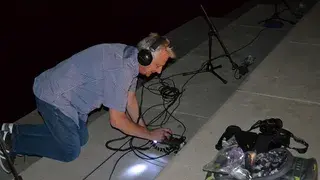
Croatia Environments - Sea Organ
Listen to Zadar’s Sea Organ through Global Sound Movement’s field recordings, capturing wave-powered harmonies along Croatia’s Adriatic waterfront.
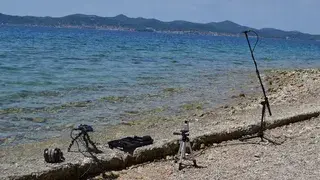
Croatia Environments
Explore Croatia Environments by Global Sound Movement: field recordings of Zadar’s Adriatic coastline, urban life, religious festivals and cultural traditions