
Morske Musak
A sonic art installation developed by the GSM that investigates the relationships between sound, architecture, environment, and participatory authorship.
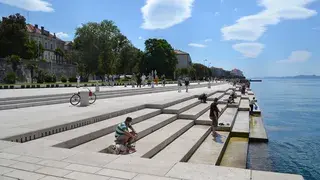
Morske Musak is an interactive sonic art installation developed by the Global Sound Movement that investigates the relationships between sound, architecture, environment, and participatory authorship. Grounded in field recordings captured at the Sea Organ (Morske Orgulje) in Zadar, Croatia—an internationally recognised architectural sound sculpture by Nikola Bašić (2005)—the work reinterprets this landmark site through practice-based research methods that extend its acoustic logic into a digitally mediated, interactive context.
The Sea Organ converts the kinetic energy of the Adriatic Sea into continuously varying harmonic tones through a system of underwater pipes embedded within marble steps. Morske Musak samples these emergent sonic processes and re-situates them within an interactive interface developed using Ableton Live, enabling participants to manipulate, layer, and recombine the sounds in real time. This positions the environment itself as a co-author within the compositional process, reframing listening as an embodied, performative, and spatial practice rather than a passive mode of reception.
The project draws on critical frameworks from sound studies and sonic art, particularly the work of R. Murray Schafer on soundscape and acoustic ecology, and Brandon LaBelle’s theorisation of sound as a social and spatial practice. In doing so, Morske Musak advances field recording beyond documentation, employing it instead as a tool for public engagement and experiential research into how sound mediates relationships between place, perception, and agency.
Addtional insight
Listen on Spotify
Discover the story of Morske Musak, a project inspired by Croatia’s remarkable Sea Organ powered entirely by the movement of the sea, now on Spotify.
Watch on YouTube
Step inside the world of Morske Musak. Inspired by Croatia’s remarkable Sea Organ, this exhibition reveals how the power of the sea can become music. Watch on YouTube.
Additional Information
Originality
Morske Musak demonstrates originality through the novel reconfiguration of an existing architectural sound sculpture into an interactive, digitally mediated compositional system. While the Sea Organ (Morske Orgulje) by Nikola Bašić (2005) is itself a pioneering example of environmental sound architecture, Morske Musak extends this work beyond its fixed, site-specific conditions by translating its emergent sonic processes into a participatory interface. This reframing enables audiences to engage with the Sea Organ not only as listeners but as co-composers, positioning the environment as an active collaborator within the creative process.
The originality of the research lies in its methodological shift: field recordings are employed not as representational or documentary artefacts, but as generative materials for public interaction and co-creation. By integrating environmental sound, architectural acoustics, and real-time digital manipulation, the project advances new forms of sonic authorship that challenge conventional distinctions between composer, performer, audience, and site. This approach contributes an original model for participatory sound practice within contemporary art and sound studies.
Significance
The research is significant in its contribution to debates within sound art, architecture, and practice-based research concerning how sound mediates spatial experience and environmental awareness. By foregrounding listening as an embodied, relational activity, Morske Musak builds on and extends key theoretical frameworks in acoustic ecology and sonic art, particularly those articulated by R. Murray Schafer and Brandon LaBelle.
Within UoA 34, the work contributes to understandings of how artistic practice can function as a mode of research that produces knowledge about place, perception, and human–environment relations. The project’s emphasis on accessibility and participation is particularly significant, as it demonstrates how experimental sound practices can engage non-specialist audiences without diluting conceptual or artistic complexity. In transforming a canonical site-specific artwork into an adaptable, interactive platform, Morske Musak offers a transferable model for artists, researchers, and institutions seeking to activate architectural sound works in new social and cultural contexts.
Rigour
The rigour of Morske Musak is evidenced through its systematic engagement with established artistic lineages, theoretical frameworks, and practice-led research methods. The project is underpinned by critical scholarship in sound studies and sonic art, including the work of Schafer, LaBelle, Truax, and Wishart, and is situated within a clear genealogy of site-responsive sound practices associated with artists such as Max Neuhaus and Bill Fontana.
Methodologically, the research involves iterative cycles of field recording, critical listening, compositional testing, and audience interaction. The use of Ableton Live as a controlled yet flexible compositional environment enables reproducible and transparent experimentation with environmental sound materials. Reflexive evaluation of participant interaction forms an integral part of the research process, ensuring that creative decisions are informed by both theoretical context and observed audience behaviour.
Through this combination of contextual grounding, methodological transparency, and reflective practice, Morske Musak meets the REF criterion of rigour by demonstrating intellectual coherence, critical engagement, and robustness in both its processes and outcomes.
Bibliography
Bašić, N. (2005) Morske Orgulje (Sea Organ). Zadar: City of Zadar.
Fontana, B. (1987) Sound Sculpture. Cologne: Kölnischer Kunstverein.
LaBelle, B. (2006) Background Noise: Perspectives on Sound Art. New York: Continuum.
LaBelle, B. (2010) Acoustic Territories: Sound Culture and Everyday Life. New York: Continuum.
Neuhaus, M. (1994) ‘Sound Works, Volume I’. New York: Dia Center for the Arts.
Schafer, R. M. (1977) The Soundscape: Our Sonic Environment and the Tuning of the World. Rochester, VT: Destiny Books.
Truax, B. (2001) Acoustic Communication. 2nd edn. Westport, CT: Ablex Publishing.
Wishart, T. (1996) On Sonic Art. Amsterdam: Harwood Academic Publishers.
Related Articles
Sound of Heritage
A sonic heritage project capturing and preserving the sounds of Lancashire’s historic spaces through field recording, archiving, and sound practice.
Hidden Melodies
Explore Hidden Melodies, a GSM research project documenting and preserving endangered musical traditions, cultural identities, and rare sonic heritage.