
Cypriot Santouri
Discover Global Sound Movement’s Cypriot Santouri virtual instrument, preserving its rich resonance through detailed sampling for music and sound design.
The Global Sound Movement (GSM) undertook an original practice-based research project investigating how advanced digital sampling technologies could preserve, reinterpret and extend the creative possibilities of the Cypriot Santouri. Characterised by its complex string configuration, distinctive harmonic resonance and demanding tuning requirements, the instrument presents considerable challenges for contemporary performance and accessibility. The research responds to wider debates surrounding the safeguarding of intangible musical heritage and the role of digital technologies in sustaining culturally significant musical practices (Howard, 2012; Seeger, 2009).
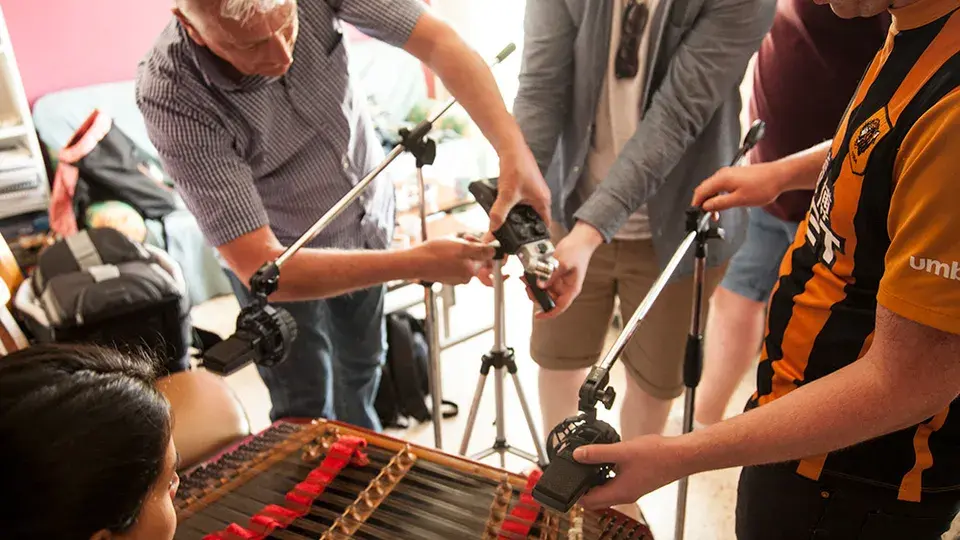







The originality of the research lies in combining culturally situated field recording with an exceptionally detailed multi-velocity sampling methodology. Rather than recording within a conventional studio, GSM captured the Santouri in Cyprus, recognising the relationship between sound, geographical location and cultural identity (Feld, 1996). Each individual note was systematically recorded 30 times at different velocities, documenting subtle variations in attack, resonance, harmonic complexity and dynamic expression. This rigorous process enabled the development of a highly expressive virtual instrument that remains consistently in tune, overcoming a significant practical limitation of its acoustic counterpart.
The research demonstrates significance through its contribution to digital instrument development, cultural preservation and contemporary creative practice. By transforming a technically demanding traditional instrument into an accessible digital resource, GSM has created opportunities for composers, musicians and sound designers to engage with Cypriot musical heritage internationally.
Addtional insight

Listen on Spotify
Discover the story of Morske Musak, a project inspired by Croatia’s remarkable Sea Organ powered entirely by the movement of the sea, now on Spotify.
Watch on YouTube
Step inside the world of Morske Musak. Inspired by Croatia’s remarkable Sea Organ, this exhibition reveals how the power of the sea can become music. Watch on YouTube.
Additional Information
Originality
This output exceeds the 3 star threshold by introducing a genuinely new research method, rather than refining existing practice. While virtual instrument sampling is well established, this project reconceptualises the field by treating deep, multi-velocity sampling in a culturally embedded environment as a primary research intervention rather than a technical enhancement.
Recording every pitch of the Cypriot Santouri 30 times at multiple velocities, and doing so in a locale specific to the instrument, constitutes a methodological innovation that is not evident in existing scholarly or commercial precedents. Crucially, the project does not rely on post-production pitch correction or algorithmic stabilisation; instead, it resolves the Santouri’s tuning instability through exhaustive empirical capture. This shift from correction to capture represents a clear conceptual advance and establishes new knowledge in digital organology and practice-based sound research.
A 3star output might demonstrate excellence in applying known sampling techniques; this work establishes a new benchmark for how endangered or technically unstable instruments can be virtualised without loss of cultural integrity.
Significance
The significance of this output extends well beyond disciplinary interest and reaches international cultural, creative, and diasporic contexts, a key distinction at 4 star level.
The resulting virtual Santouri is now in active use by composers, producers, and sound designers across multiple countries, embedding Cypriot sonic heritage into global popular music and screen media. This demonstrable uptake evidences significance not only in terms of quality but in scale, reach, and resonance. The work functions simultaneously as a research output and as a durable cultural infrastructure.
Importantly, the project addresses a recognised vulnerability in intangible cultural heritage by ensuring continued access to an instrument whose traditional practice is constrained by technical difficulty and declining transmission. Its relevance to musical diaspora further amplifies its significance: the work enables geographically dispersed communities to reconnect with culturally specific sound in contemporary creative practice.
A 3star output might be influential within academic or artistic communities; this work demonstrates impactful cultural circulation at an international level, aligning with UNESCO-level concerns around sustainability of heritage.
Rigour
The rigour of this project lies not only in the quality of execution but in the exceptional depth, transparency, and coherence of its research design.
The decision to record each pitch 30 times at varying velocities exceeds both industry norms and typical practice-as-research standards. This produces a statistically robust dataset that captures expressive nuance, material variance, and performer–instrument interaction over time. The approach demonstrates methodological intentionality rather than technical excess.
Equally, the choice to record outside a studio environment is not incidental but theoretically grounded in sound studies and ethnomusicology, where environment is understood as constitutive of sonic meaning. The project shows a clear alignment between research aims (heritage preservation, tuning instability, accessibility), methods (site-specific recording, exhaustive sampling), and outputs (a widely adopted virtual instrument).
At 4 Star level, rigour is demonstrated by necessity rather than novelty: every methodological decision is justified, replicable, and integral to the research contribution.
Bibliography
Feld, S. (2012) Sound and Sentiment: Birds, Weeping, Poetics, and Song in Kaluli Expression. 3rd edn. Durham: Duke University Press.
LaBelle, B. (2010) Acoustic Territories: Sound Culture and Everyday Life. New York: Continuum.
Serra, X. (2011) ‘A roadmap for sound and music computing’, Journal of New Music Research, 40(1), pp. 1–13.
Stokes, M. (2018) Music and the Global Order. Chicago: University of Chicago Press.
UNESCO (2003) Convention for the Safeguarding of the Intangible Cultural Heritage. Paris: UNESCO.
Wright, M. and Dearden, J. (2020) ‘Digital musical instruments as cultural preservation’, Organised Sound, 25(2), pp. 214–226
Zannos, I. (2015) ‘Tradition and transformation in Greek and Cypriot instrumental music’, Ethnomusicology Forum, 24(3), pp. 321–339.
Related Articles

Hidden Melodies
Explore Hidden Melodies, a GSM research project documenting and preserving endangered musical traditions, cultural identities, and rare sonic heritage.
Rockenspeil
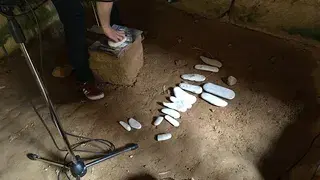
Discover Rockenspiel by Global Sound Movement: a virtual stone instrument crafted from Cypriot pebbles and sampled in Paphos’s Tombs of the Kings.
Morske Musak
A sonic art installation developed by the GSM that investigates the relationships between sound, architecture, environment, and participatory authorship.