
Acorn Music
Experience Acorn Music at Acorn Bank: a sonic art installation blending birdsong, field recordings and adaptive sound design with the changing seasons.
Acorn Music is a site-responsive sonic art installation situated at Acorn Bank that investigates the aesthetic, ecological, and cultural dimensions of birdsong and seasonal soundscapes through practice-as-research. The work combines long-form field recordings of avian and environmental sound with an adaptive sound design system that interacts with the site’s live acoustic environment, allowing the composition to evolve dynamically across seasonal cycles. In doing so, Acorn Music positions sound not as a fixed artefact but as an ecological process shaped by place, time, and non-human agency.
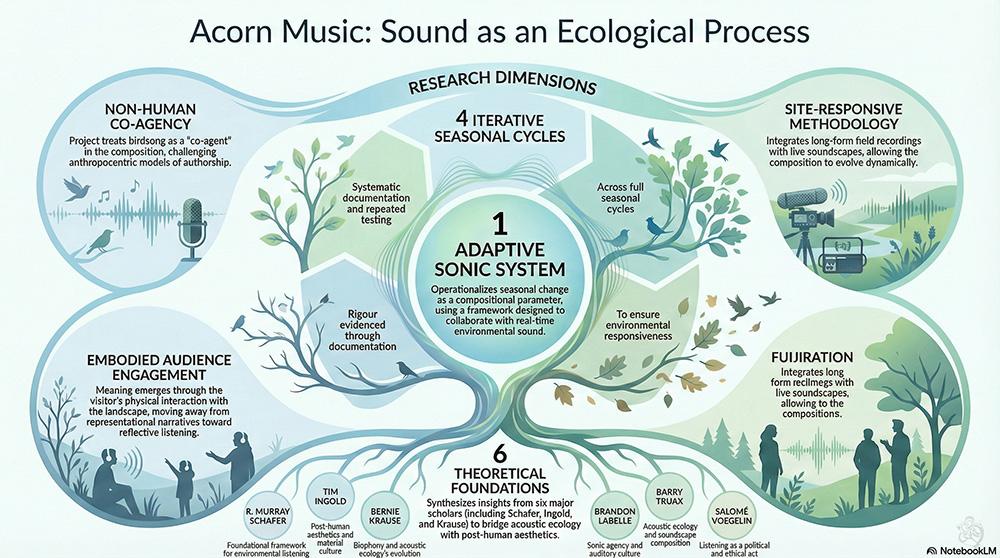
The research is grounded in sound studies and acoustic ecology, drawing on traditions that frame listening as an embodied and ethical practice (Schafer, 1994; LaBelle, 2010). By foregrounding birdsong as both musical material and ecological indicator, the installation aligns with contemporary scholarship that understands environmental sound as a form of situated knowledge (Ingold, 2007; Krause, 2012). The work extends these ideas through artistic practice, testing how compositional systems can respond to real-time environmental conditions and long-term seasonal change.
Audience engagement is central to the research methodology. Visitors encounter Acorn Music while moving through the landscape, where listening becomes a reflective act that mediates relationships between human presence and non-human sound worlds. This approach resonates with participatory and site-specific practices in sonic art, in which meaning emerges through interaction with place rather than through representational narrative alone (Truax, 2008).
As practice-as-research, Acorn Music contributes new knowledge by demonstrating how adaptive sonic systems can articulate ecological temporality and foster environmental awareness. The project offers a rigorously documented artistic framework for integrating field recording, sound design, and ecological listening within contemporary performance and installation contexts, directly addressing UoA 34 concerns with experimental music practice, sound art, and interdisciplinary performance research.
Shop the sounds

Weather Atmospheres
This comprehensive Weather Atmospheres Sound Pack offers a wide array of high-quality recordings to capture the essence of weather in all its forms.

Natural World Atmospheres
Explore the rich diversity of the natural world - featuring high-quality recordings from Uganda, other parts of Africa, the UK, China, Cyprus, Gibraltar, and Bali.
Additional Information
Originality
Acorn Music demonstrates originality through the development of a site-responsive sonic system that integrates long-term ecological temporality into contemporary sound art practice. While birdsong and field recording are well-established within experimental music and acoustic ecology, the project advances the field by operationalising seasonal change as a compositional parameter rather than a contextual backdrop. The work’s adaptive sound design framework—designed to collaborate with real-time environmental sound rather than overlay or represent it—extends existing approaches to soundscape composition (Schafer, 1994; Truax, 2008).
The research is further original in its treatment of non-human sound sources as co-agents within the compositional process. By foregrounding birdsong as both musical material and ecological signal, Acorn Music challenges anthropocentric models of authorship in music and performance, contributing new artistic insights to debates around post-human and ecological aesthetics in sound art (LaBelle, 2010; Voegelin, 2010).
Significance
The significance of Acorn Music lies in its contribution to contemporary understandings of how sonic art practice can mediate relationships between humans, environments, and non-human life. The project offers a compelling model for environmentally engaged composition that is accessible to diverse publics through its placement within a heritage landscape. Audience encounters are informal, embodied, and durational, encouraging modes of listening that foster environmental awareness and reflection rather than didactic interpretation.
Within UoA 34, the work contributes to ongoing discourses around site-specific performance, experimental music practice, and interdisciplinary research methodologies. Its relevance extends beyond music into environmental humanities and ecological art, demonstrating the capacity of practice-as-research to address pressing cultural concerns around sustainability and environmental stewardship.
Rigour
The research underpinning Acorn Music is methodologically rigorous, combining established techniques in field recording, soundscape composition, and installation design with sustained critical engagement with sound studies and acoustic ecology scholarship. The project is informed by a clearly articulated theoretical framework, drawing on peer-reviewed literature (Ingold, 2007; Krause, 2012) to contextualise artistic decisions.
Rigour is further evidenced through systematic documentation of the installation’s development, including iterative testing across seasonal cycles, reflective practice, and audience observation. The work’s adaptive system was refined through repeated deployment and evaluation, ensuring that compositional outcomes were both conceptually coherent and environmentally responsive. This sustained, reflective process positions Acorn Music as a robust example of practice-as-research within UoA 34.
Bibliography
Ingold, T. (2007) The Perception of the Environment: Essays on Livelihood, Dwelling and Skill. London: Routledge.
Krause, B. (2012) The Great Animal Orchestra: Finding the Origins of Music in the World’s Wild Places. New York: Little, Brown.
LaBelle, B. (2010) Acoustic Territories: Sound Culture and Everyday Life. New York: Continuum.
Schafer, R. M. (1994) The Soundscape: Our Sonic Environment and the Tuning of the World. Rochester: Destiny Books.
Truax, B. (2008) ‘Soundscape Composition as Global Music’, Organised Sound, 13(2), pp. 103–109.
Voegelin, S. (2010) Listening to Noise and Silence: Towards a Philosophy of Sound Art. London: Continuum.
Related Articles

Sound of Heritage
A sonic heritage project capturing and preserving the sounds of Lancashire’s historic spaces through field recording, archiving, and sound practice.

Hidden Melodies
Explore Hidden Melodies, a GSM research project documenting and preserving endangered musical traditions, cultural identities, and rare sonic heritage.
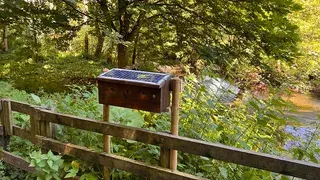
Croodlebeck; Poetry In Situ
Discover Croodlebeck: Poetry In Situ at Acorn Bank, a solar-powered sound installation bringing Dorothy Una Radcliffe’s poetry into its inspiring landscape.